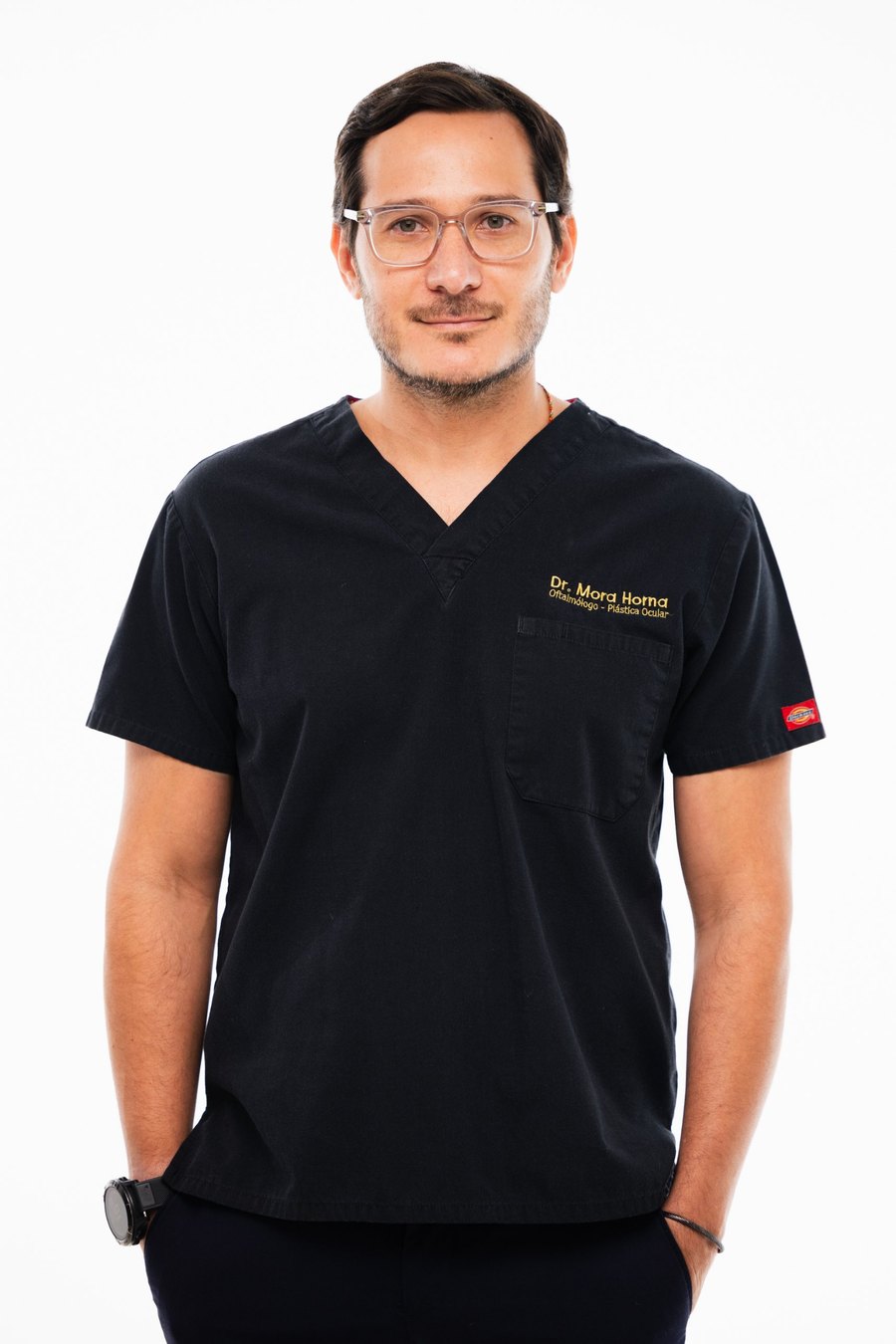
Dr. Eduardo Mora HornaOphthalmologist · Oculoplastics Book an appointment
ESEN

Dr. Eduardo Mora HornaOphthalmologist · Oculoplastic surgery

Dedicated to the complete care of your vision. Specialist in cataract surgery, dry eye treatment, and oculoplastic surgery of the eyelids and tear ducts.

+3.000surgeries performed
+10years of experience
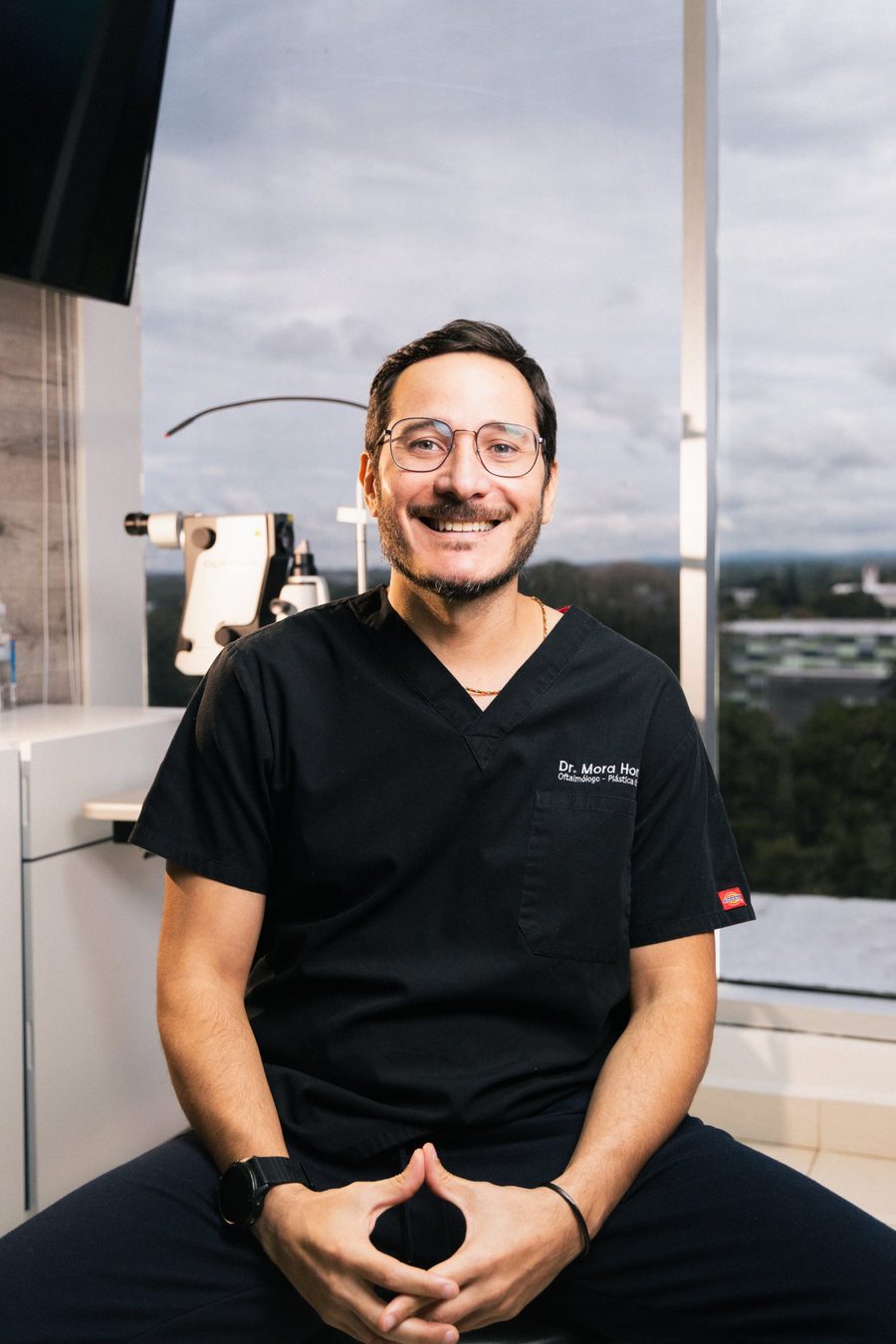
Dr. Eduardo Mora Horna in his office
Residency in SpainOphthalmology at San Cecilio University Hospital, Granada.
Oculoplastics in MexicoFellowship at the Asociación para Evitar la Ceguera en México.
Orbis InternationalOphthalmologist on the Flying Eye Hospital from 2019 to 2023.
Services

Cataract, dry eye and eyelids

Cataract surgery

Clear up cloudy vision with outpatient surgery and an intraocular lens chosen for you.

Learn more

Dry eye

Keratograph diagnosis and treatment based on the cause, including IPL, Jett Plasma and punctal plugs.

Learn more

Oculoplastic surgery

Droopy eyelids, excess skin, eyelids turning in or out, lesions, and watery eyes from blockage.

Learn more

General ophthalmology

Complete eye exams, eye pressure checks, and follow-up for conditions like glaucoma and diabetes.

Learn more

Need an OCT, visual field or another test? We have diagnostic equipment for your tests. Ask at your clinic.

Google reviews

What my patients say

Reviews originally written in Spanish have been translated.

Our father has regained his sight and, with it, his quality of life. We are very grateful for Dr. Mora's work.
Joha E.Relative of a surgical patient
This doctor is a success to me. He operated on my 92-year-old mother and she sees 100%.
Violedis A.Daughter of a surgical patient
Excellent personalized care and modern specialized equipment. I am very grateful that they followed my progress and recovery after the surgery.
Vasthi G.Patient
Personalized, timely care. Very diligent and thorough, with cutting-edge technology. A humble and dedicated doctor.
Moisés C.Patient
The care was excellent. He clearly explained the treatment and surgery for my mother's eyes.
Damaris R.Daughter of a surgical patient
Dr. Mora was very nice and knowledgeable about my procedure. He explained carefully what was wrong and was able to remedy the problem. It was very helpful that Dr. Mora spoke English.
Suzy M.Patient
Appointments by WhatsApp

Message the clinic closest to you

Payment methods:VisaMastercardClaveYappyCash
About me

A Panamanian ophthalmologist trained in three countries

I studied medicine at the University of Panama, completed my ophthalmology residency in Granada, Spain, and my oculoplastics fellowship in Mexico City.

For four years I was an ophthalmologist on Orbis International's Flying Eye Hospital, an eye hospital on board a plane that brings surgery and training to countries around the world.

Today I see patients in David, Santiago de Veraguas and Boquete, close to my patients in western Panama.

Dr. Eduardo Mora Horna
Career

Training and experience

  1. Medicine

    Doctor of Medicine

    University of Panama. Internship at Hospital Santo Tomás and Hospital Aquilino Tejeira, Penonomé.

  2. 2010–2014

    Residency in Ophthalmology

    San Cecilio University Hospital, Granada, Spain.

  3. 2014–2015

    Fellowship in Oculoplastic Surgery

    Asociación para Evitar la Ceguera en México, Mexico City.

  4. 2015–2019

    Ophthalmologist, Ministry of Health (MINSA)

    Hospital Luis "Chicho" Fábrega, Santiago de Veraguas.

  5. 2017–present

    Private practice in Santiago

    Santiago de Veraguas.

  6. 2019–2023

    Staff Ophthalmologist, Orbis International

    Flying Eye Hospital.

  7. 2019–present

    Private practice in David

    Hospital Chiriquí.

Services

Cataract, dry eye and oculoplastic surgery

Cataract surgery

See clearly again

A cataract is a clouding of the eye's natural lens. It is corrected with outpatient surgery that replaces it with an intraocular lens.

  • Cataract evaluation and the right time to operate
  • Pre-operative tests and precise lens calculation
  • Outpatient surgery with intraocular lens implant
  • Monofocal lens or premium lenses: toric, multifocal and extended depth of focus (EDOF)
  • Follow-up visits after surgery
Dry eye

Burning, grittiness, vision that comes and goes

Dry eye is one of the most common causes of eye discomfort. We measure it objectively to treat the cause, not just the symptoms.

  • Keratograph diagnosis: tear quality and meibomian glands
  • Treatment based on the cause: drops, eyelid hygiene, IPL and Jett Plasma
  • Punctal plugs to keep tears in the eye
  • Follow-up with measurements before and after treatment
  • Preparing the eye surface before cataract surgery
Cataract surgery

Intraocular lens options

In cataract surgery, the natural lens is replaced with an intraocular lens. All of them give clear vision; the difference is how much you will need glasses afterwards. We help you choose based on your tests and your lifestyle.

Standard

Monofocal lens

Sharp distance vision

The most widely used lens, with excellent quality of vision and very few halos at night. Reading glasses are usually needed for near vision.

Premium

Toric lens

For people with astigmatism

Corrects astigmatism during the same surgery, for sharper distance vision without relying on glasses.

Premium

Multifocal lens

Distance, intermediate and near

Lets you see far, at middle distance and to read, with the least possible need for glasses. It can cause halos around lights at night.

Premium

Extended depth of focus lens (EDOF)

Distance and intermediate

Gives continuous vision from far away to computer or phone distance, with fewer halos than a multifocal. Reading glasses may be needed for very small print.

Toric lenses also come in multifocal and extended depth of focus versions.

General ophthalmology

Checkups and care for your eyes

Tap a service to learn more.

Complete eye exam

A check of the whole eye, inside and out.

Includes visual acuity, slit-lamp exam, eye pressure, and a retina exam when needed. Recommended once a year, or sooner if you notice changes in your vision.

Glaucoma

Detecting and controlling eye pressure.

Glaucoma has no symptoms at first. We measure eye pressure, evaluate the optic nerve, and follow up with tests when needed.

Eyes and diabetes

Retina checkups for people with diabetes.

Diabetes can damage the retina without causing symptoms. We recommend a retina exam at least once a year.

Red eye

Redness, burning and discharge.

We find the cause of the red eye to treat it, not just soothe the symptoms.

Laser procedures

In-office laser

Quick procedures, with no incisions or hospital stay, done in the office.

YAG capsulotomy

"Cleaning" the artificial lens after cataract surgery.

Months or years after cataract surgery, the capsule that holds the intraocular lens can become cloudy and vision blurs again. The YAG laser opens a window in that capsule and vision clears within minutes. It is painless and does not require an operating room.

Laser iridotomy

Preventing angle-closure glaucoma.

In eyes with a narrow angle, the laser makes a very small opening in the iris so the eye's fluid can circulate and pressure does not rise suddenly. It prevents an acute glaucoma attack.

SLT (selective laser trabeculoplasty)

Pressure control in open-angle glaucoma.

The laser acts on the eye's drainage system so fluid drains better and pressure goes down. It can reduce, or in some cases replace, glaucoma drops.

Oculoplastic surgery

Eyelids and tear ducts

Oculoplastic surgery treats problems of the structures that surround and protect the eye, caring for both function and appearance.

Blepharoplasty

Excess eyelid skin.

Removes excess skin and bags from the eyelids. It can improve your field of vision when the skin blocks it, as well as your appearance.

Eyelid ptosis

Droopy eyelid.

Corrects an eyelid that droops over the eye because the muscle that lifts it is weak.

Entropion and ectropion

Eyelid turning inward or outward.

When the eyelid turns inward, the lashes rub the eye; when it turns outward, the eye waters and gets irritated. Both are corrected with surgery.

Eyelid lesions

Moles, cysts and tumors.

Evaluation and removal of eyelid lesions, with pathology testing when needed.

Chalazion

A small bump on the eyelid from a blocked gland.

It forms when an eyelid gland gets blocked. If it does not improve with warm compresses and medical treatment, it is drained with a short in-office procedure.

Trichiasis

Eyelashes growing toward the eye.

Misdirected lashes rub the cornea and cause irritation and tearing. They are treated by cauterizing the lash root so it does not grow back, and with eyelid surgery when the cause is the position of the lid margin.

Tear ducts

Constant tearing from a blockage.

Diagnosis and treatment of tear duct blockage, including surgery to open a new drainage path.

Tear duct openings (puncta)

Tearing from narrow or blocked puncta.

The puncta are the small openings on the edge of the eyelid where tears drain. When they narrow or close, the eye waters. They are opened with a simple procedure and, when needed, perforated plugs are placed to keep them open.

Conjunctiva

Eye surface

Treatment of growths and lesions on the clear layer that covers the white of the eye.

Pterygium

Fleshy growth spreading onto the cornea.

Tissue that grows from the white of the eye onto the cornea, linked to sun and wind. When it irritates, grows or affects vision, it is removed surgically, using techniques that lower the chance of it coming back.

Conjunctival lesions

Spots and growths on the white of the eye.

Evaluation and removal of conjunctival lesions and neoplasms, with pathology testing to confirm the diagnosis and plan treatment.

Locations

Which clinic is closest to you?

Send a WhatsApp message to the clinic where you would like to be seen.

Payment methods:VisaMastercardClaveYappyCash

Follow me on Instagram: Instagram@dr.eduardomora

Clinic in David

Hospital Chiriquí

Hospital Chiriquí, Torre Nueva, 5th floor, office #41, David, Chiriquí.

Monday, Tuesday and Wednesday.

Frequently asked questions

Before your visit

What should I bring to my appointment?

Your current glasses, a list of the medications you take, and any previous eye test results you have.

Will my pupils be dilated?

Sometimes it is needed to examine the retina. If so, your vision will be blurry and sensitive to light for a few hours: come with someone, do not drive, and bring sunglasses.

How often should I have my eyes checked?

Once a year from age 40, even if you see well. If you have diabetes, glaucoma or a family history, also once a year or as often as your doctor advises. Come in sooner if you notice changes in your vision.

When should I have cataract surgery?

When cloudy vision starts to affect your daily life: driving, reading, watching TV or working. There is no need to wait for the cataract to "ripen".

Does cataract surgery hurt? What is recovery like?

It does not hurt: numbing drops are used and it usually takes less than half an hour. It is outpatient surgery, so you go home the same day. Vision improves within a few days and you will use eye drops for a few weeks.

Which intraocular lens is right for me?

It depends on your tests, whether you have astigmatism, and how you use your eyes day to day. At your visit we review the options together: a monofocal lens or premium lenses (toric, multifocal or extended depth of focus).

What tests do I need before cataract surgery?

Eye tests: mainly biometry to calculate the lens and, depending on your case, endothelial cell count, macular OCT, dry eye analysis or Pentacam.

General tests: blood tests and an electrocardiogram. If you have diabetes, high blood pressure, heart disease or other conditions, also an internal medicine evaluation before surgery, so you can have it safely.

We will tell you which ones you need at your visit.

Where do I get my tests done?

In David: at Oftalmo Diagnóstico, Hospital Chiriquí, Torre Nueva, 5th floor, office #18. WhatsApp 6323-4166. More information at oftalmodiagnostico.com

In Santiago: OCT, visual field testing and A-scan ultrasound are done at the office.

At your visit we will tell you which tests you need and where it is best to have them done.

I had cataract surgery and my vision got cloudy again. Is that normal?

It can happen months or years later. The capsule that holds the lens becomes cloudy, and it is corrected with a YAG laser capsulotomy, which "cleans" the artificial lens. It is quick, painless and done in the office.

How do I know if I have dry eye?

The most common symptoms are burning, a gritty feeling, tired eyes, vision that comes and goes and, oddly enough, watery eyes. With the Keratograph we measure your tears and eyelid glands to confirm it and treat the cause.

What payment methods do you accept?

We accept cash, Visa and Mastercard, Clave and Yappy.

How do I book an appointment?

Send a WhatsApp message to the clinic where you would like to be seen: David 6979-7170, Santiago 6632-1171 or Boquete 6436-9531. You will find the buttons in the Locations section.